

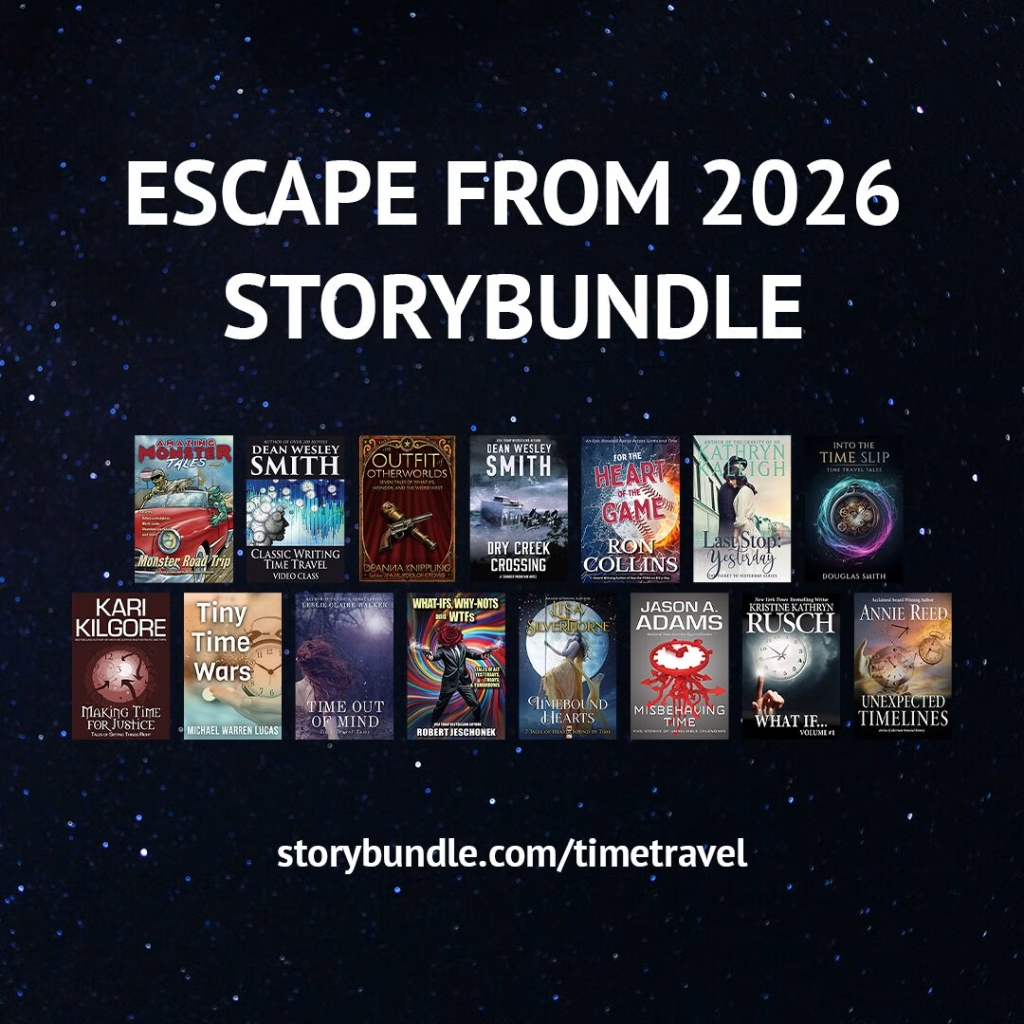
What if…what we think of as escapism isn’t limited to entertainment that doesn’t have deep underpinnings?
What if…science fiction is particularly suited to asking deep questions that enhance the fun of how escapist the story is?
Time travel and alternate history fiction might be the best examples of that.
Escapist fiction: fiction which helps the reader escape the present moment, to look away when seeing things straight on becomes too much. A way of handling trauma, stress, worry, and overwhelm. To step out of one’s own life and into someone else’s for a few hours can help us let go of the things that we need to move past. Everything from a bad breakup to the general state of the world. It’s too easy to become rigidly fixed on the things that cause us suffering, to get so wound up that we make ourselves worse off by worry for the future or grief for the past.
Sometimes we all need something to help us let go.
Examples of Not Quite Light and Fluffy (But Still Escapist)
Over the past few years, I’ve had my share of stress and heartache from different sources. (I’m sure you have, too.) I’ve noticed something about the stories I turn to for relief on days where I feel like I can’t function anymore: the stories I’m reading aren’t always stereotypically light and fluffy. They have some depth to them; they’re just not in my face about it. Kind of like a kind friend who sits with you on the worst days of your life just to be present—but who can also talk about what’s hurting you, if and when you can handle it.
The first book where this struck me was The Time Traveler’s Wife, by Audrey Niffenegger. I read it while I was trying to numb myself to some things I didn’t want to see. I can’t say the book helped me see them directly, but it did help me keep writing at a time when I felt like giving up on it.
The short version of the story is that it’s a romance between an artist and a man who has a genetic disorder that makes him travel through time. He’s unable to control himself. The author says she wrote the book as a metaphor for her failed relationships, a sort of extended (dark) irony about how two people can meet at literally the wrong time.
The book is slow-paced, over five hundred pages long, full of vivid details, sharp and bitter, and yet also one of the best love stories ever written. And when I was done with it, I felt better about writing and generally existing, even if my problems hadn’t actually been resolved.
Then, a couple of years later, I ended up spending more time than anticipated with someone I had to be polite to but didn’t have anything in common with.
Except that it turned out we had both read this book during a rough period and had had the same reaction: heartbreak, ironic amusement, bittersweetness.
The Time Traveler’s Wife is not a light and fluffy escapist tale, but an escapist tale it is.
Is it deep? Important? A Great American Novel?
Hm. It’s hard to answer those questions, really. It is but it isn’t, but then again maybe it is.
At any rate, we both agreed: we didn’t know why the time travel element was important, but trying to imagine the story without it, well, the book would have been fine but it wouldn’t have hit so hard.
Another book. This time not a time travel book, but an alternate history one: Watchmen by Alan Moore. (I could have picked Maus by Art Spiegelman, but I haven’t had as many in-person discussions about that one.)
I read Watchmen a little late.
The issues started coming out in 1986 (and the main storyline is set in 1985), but that was before I got back into reading comics and graphic novels. I grew up reading Marvel and DC out of a big box of my uncles’ comics in my grandfather’s basement, but once I got through with those, there wasn’t a lot of money or access to read them more often. In college I had nerd friends and borrowed a lot of comics; we would also drive up to Minneapolis to see friends and stop at Uncle Hugo’s and DreamHaven. Even so, I didn’t read Watchmen until the 2000s, after I was married and living in Colorado Springs and had a kid and making a point to read great geek-adjacent stuff that I’d missed along the way. The movie came out in 2009; it was before then for sure, but maybe not by much. I’d finished it before the movie was announced, anyway.
By the time I read Watchmen, my geek friends had read it like a decade or more before, and their memories of it had faded to nostalgia. I’d mention that I’d read Watchmen and they wanted to talk about old superhero arcs they loved and X-Men movies and how Doc Oc was on point in Spider-Man 2.
But one of my friends did listen to me go off about Watchmen and how exciting it was and how many twists and turns it had, and how initially I’d hated the running strip at the bottom about the pirates, but the more I read it, because I read Watchmen like five or six times in a row, the more I liked it and felt it was the heart of the story.
In turn, he talked a bit about what it was like to live through a lot of the real historical periods in the book. My friend is a decade older than I am, and I think just barely missed getting drafted for the Vietnam War. (I had another friend who was in it, but he never talked about it as such, just once about how weird it was, coming back.) He talked about how moving it was to see a time that he had experienced as “the past.”—He didn’t talk about it making him feel old; he talked about how it made him feel seen.
Because even though it was alternate history, it felt more right than the real history.
He had grown up reading a cousin’s (I think?) war comics and Westerns and horror comics (which were of the Tales from the Crypt-slash-“The Monkey’s Paw” variety than more literary ones that you can get today). He had never really stopped being a comics reader and fan (or a general SF/F fan; he had something like ten thousand books in his apartment, mostly paperback, stacked three deep on industrial shelving). His brain was full of stories—stories that had gotten him through a lot of shit.
And to him, Watchmen was a story about stories that had gotten him through a lot of shit, a way of taking stock of how the real world and the fictional world sometimes overlapped.
It wasn’t just nostalgia for comic books or the 1980s that made Watchmen cool for him. It was the way it eviscerated some of that nostalgia, satirically, without invalidating it. The past was still cool in a way that reflected the perceptions of the time. The satire pointed out the ironies, that was all, where in the 1980s the people we idolized were the worst thing that could possibly happen to us, which maybe we deserved…where the bad guys ended up small and sad and powerless…where the more you fought to escape a system, the more deeply embedded in and responsible for it you were.
An alternate history that was more 1980s than the 1980s, which tried to be fabulous and shallow but were mostly fake wood paneling and dirty cigarette ashtrays.
Of course, being me, I thought, “Huh. I wonder if I could ever write that.”
Looking back, I think I already had.
Playing What If
I recently put together a collection of my Weird West stories for a group project. I’ve been writing Weird West stories since the early 1990s. I grew up in South Dakota and was exposed to a lot of Western mythology growing up. I was tired of the myth about how rugged individualism was better than cooperating with anyone outside your own family or small town (while witnessing the backstabbing and unethical back-door deals in both). I was tired of the myth that one person was sufficient to decide what justice was, and that all laws were stupid. I was tired of the racism and the classism; nobody can be classist quite like someone who is barely scraping by; some of my friends weren’t considered good enough and others were uppity—aside from the fact that some of my friends weren’t white.
The myths were wrong: interlopers in white hats did not solve everyone’s problems and ride off into the sunset. They showed up, bullied everyone into compliance, and grew wealthy while everyone else scraped by, getting a boost of “generosity” every once in a while to keep stringing them along.
Sometimes my family was on the side of the interloper; sometimes we were the ones trying to scrape by. A couple of times we were both.
So I wrote stories about that.
Going over them, I discovered that a lot of the stories—not all—were science-fiction based. Some were pure horror; others were noir. Dark. Those ones…didn’t feel escapist. At all. They felt like purging poison. I was not acting as a friend in those stories; I was the person suffering who needed one.
But the SF ones, even the ones that I wrote pretty early on, had more distance to them. I wasn’t just writing about being in that situation and being hurt by it (bearing witness, maybe), but writing more on the level of, “I see this pattern happening…let’s play with it.”
I wasn’t shouting off the top of a building as such; I was just going, “Hm…if we moved a few of these chess pieces…or maybe turned this bishop into a sheriff…yes…that’s an interesting effect.”
I wasn’t playing chess, though. I was playing one of the greatest human games of all time: What If.
Some of those games aren’t pretty. I spent a lot of time looking at how the nicest, sweetest people I was close to were racist as fuck; that’s probably the strongest theme through the earlier Weird Westerns I wrote. Another story was about how money destroyed everything in its path, and wondering where that had come from. (No answers there, unfortunately.) Another one was about how humanity keeps trying to control everything, gets our egos caught up in the situation, and how letting go of that control is probably the right answer. Another couple of them were about trying to survive in a world being left behind by progress. All of them are stories that fit on a frontier in one way or another, whether that was in the traditional American West or a far-future tale out in space.
I struggled to figure out what made those stories different; I was considering more Weird West stories, but I knew the other ones didn’t belong. It wasn’t just that the stories I picked had something to do with science fiction or with some element of time. Those were just handy tools to get the point across.
I thought about it and decided that for that collection, the thing those stories all had in common was describing what America is, when it doesn’t have the weight on institutions to rely on.
When there is no real legal system, only a courthouse a hundred miles away with a traveling judge that’s six months or three solar systems away, what is justice?
When there are no schools because society has fallen apart, who passes on knowledge? And how is that knowledge affected? Do you learn more or less that way? Or is it just different?
What is “other,” when what you are isn’t well defined? Who’s alien, when you’re the invader?
What is America, when you let irony and satire creep in?
I’ve had more time to think about it since then, and expand the idea outward from my book of short stories (An Outfit of Otherworlds) to the overall niche of similar things.
What I think is:
Sometimes when you’re looking for escape, what you’re looking for is not escape from all conflict or thought, but an escape from a single-minded, immediate perspective.
That is, we’re too stuck in this moment to see anything else.
The escape that we crave isn’t always in simplicity. (Sometimes it is!) The escape we crave is in perspective and play, or distance and low-stakes experimentation.
Stories set purely in a current-day realistic world, well, it’s hard to pull that off.
Romance tends to use the intensity of falling in love to help readers out of the current moment; horror tends to use the intensity of fear. Adventure and thriller stories use adrenaline.
But those stories don’t also give us distance.
Science fiction—the kind that plays what if rather than the kind that is just adventure with ray guns—does. This is what time travel and alternate history fiction does that other genres can struggle to match.
Time travel stories give us distance from the here and now and ask what if we change the past. Or the future. Alternate history stories give us distance from the present by taking us to the past; they give us what if by overturning its assumptions. My stories that put the feel of the American frontier on another planet took us away from here and now and asked what if the same dynamics would play out on other worlds, or whether frontier stories would only exist on Earth. And so on.
The adventures, the romances, the horror—all of that can and should still happen. Science fiction, I think, falls flat when there isn’t an element of play, where the extrapolation is taken so seriously that it becomes a one-sided rant, that is, not real exploration at all.
I’m also not saying that other genres without a happy touch of science fiction can’t pull this off. A lot of light and fluffy books come with a call to lasting, real exploration of real-world situations. But I do feel science fiction is uniquely suited to the job.
So. As I write this, it’s 2026.
Pure fluff will help us survive 2026…but it may not help us get out of the terrifying mess we’re in. Some distance, some satire, some humor, some nostalgia tinged with self-awareness, some anger, some absurdity: those also might be what we need to get through this.
The Escape from 2026 Storybundle runs from May 28 through June 25, 2026, and is available for as little as $5. Fifteen authors, one question: what if?
You can find the (short) articles on each of the books here:
- Dean Wesley Smith’s Dry Creek Crossing – navigating time’s chaos
- Douglas Smith’s In the Time Slip – catharsis
- Amazing Monster Tales: Monster Road Trip – metaphors for a changing world
- Kathryn Kaleigh’s Last Stop Yesterday – escaping modern meaninglessness
- Leslie Claire Walker’s Time Out of Mind – escaping the present to look for peace of mind
