

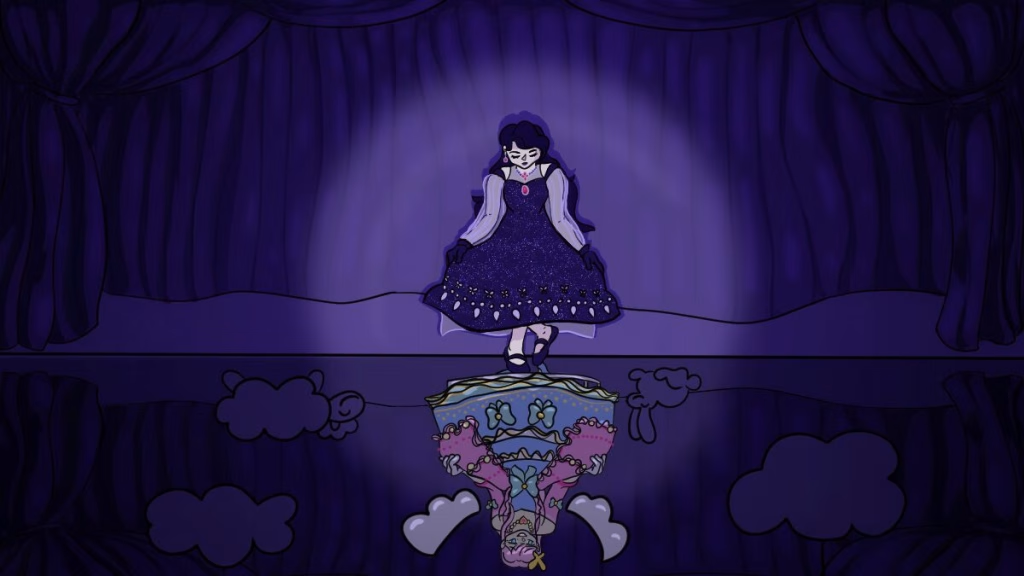
Villainess Manga & Why Read Them in the First Place
When you’ve read enough villainess manga—comics following a female protagonist reviled by the seeming heroes of the story—they start to blur together in a peculiar way, right?
The villainess manga you read just seem to keep smooshing together for some reason, and now everything you read just seems to become… blander.
When a reader stops and thinks about villainy and only finds themself in stories stuffed with bland fluffing, all that really can be done is to think, “How? How did things become this way? How did all the theatrics of being the villain get sucked away?”
It is time for a change. A change that can only be found by looking deeper into what sucked the life out of what was once great.
Villainess manga are comics that feature a main character who is referred to as a “villainess.” Often, our main character either transmigrates into a story as the villainess or our main character was a villainess in her past, and has now decided to change her life through various methods. These allow the main character to face a variety of circumstances while retaining her villainess title.
She transmigrates and decides to become a baker instead of a villainess? A well-known niche of the subgenre. She travels into the past to exact her revenge in a cruel and unusual manner? A common occurrence for villainesses. A villainess who’s trying to survive a murderous family by assuming a murderous persona while trying to escape? A favored selection of the subgenre: Roxana. All falling under the Villainess manga subgenre.
Why, then, classify them as Villainess manga, instead of Cooking or Revenge or Psychological?
Villainess manga focus on girlhood and expressing its “negative aspects.” Our protagonists aren’t heroines or side characters. They’re women who are meant to be seen in a negative light. Their stories—a villainess’ fall from grace, her rises and failures, her choices, her very life—become a guide on leaving unfavorable situations. A guide to navigating the negative side of society to live a better life. A guide to when misbehaving is the best way to overcome life’s challenges.
Also, and this is very important, sometimes Villainesses are just cool.
The Problem with Villainess Manga Now
The villainess role within this genre, ironically, often remains unexplored and unexploited. Authors have resorted to parading heroines as villainesses and assuming readers will not notice the carved hole where a villainous heart used to lie.
These heroine-villainesses wear black hair instead of heroine pink. Blood red dresses instead of innocent pale blue. They dress as villainesses while still keeping the goals and personalities of heroines. And in doing so, these heroine-villainesses become easier to market as the currently hot Villainess manga subgenre, but removed from the depth of emotion they once held as actual villainesses.
The prioritization of profit has subverted the niche genre’s original purpose and character.
A villainess, unlike a heroine, should not be someone who is swaddled; she is someone who has been socially ruined and now has to confront the consequences of her actions. She should not be someone who sweeps in with grand ideas and inventions and easily makes herself a social queen.
A villainess should be a woman who explores the darker side of life—wherein pain is a question of “when,” and not “if”—not to bathe in the light and soothe the reader with comforts.
How did this change happen? How have villainess stories gone from character exploration to yet another heroine fantasy?
Well, it happened because of wish fulfillment. (And money and capitalism, but that’s not very specific in this current age.)
Purely Wish Fulfillment in Villainess Form
What does wish fulfillment mean in a Villainess manga? Isn’t all art a form of wish fulfillment? Somewhat, but not to the extremes being brought into Villainess manga that are causing the whole subgenre to invert their stories’ messages.
What’s currently flooding the villainess subgenre is purely wish fulfillment, wherein stories have been made purely to satisfy a specific need and not dig deeper into the “why.” These pure wish fulfillment stories fill a reader’s particular itch for narrative elements… but neither explores deep enough to get at the cause of that narrative itch nor explores why a reader would want to have that itch satisfied in the first place.
These types of stories will scratch the surface of an emotional itch, like having characters do hobbies a reader can’t in their daily life, without looking at why those hobbies are something hard to do on the regular, or why those hobbies are a goal the main character wants to reach for. Instead, these stories focus on accomplishing a hobby and end the story there.
This lack of depth could be enjoyable in other genres, but within Villainess manga the purpose becomes distorted to the point where a reader would question why they even bothered. No longer is the story looking behind the curtains on why that hobby was out of reach for the reader in the first place. Instead, a purely wish fulfilling story actively sweeps the reasoning under a rug so readers won’t have to look at the uncomfortable truths that Villainess manga were originally made to look at. The whole subgenre becomes another bargain-bin story that is easily interchangeable with any other bargain-bin story.
Similar in lacking, this subgenre change could be compared to removing the salty parts from trail mix to leave behind a bag of M&M’s, and then asking why the trail mix feels unsatisfying to eat now. The substance has been removed!
These trail-mix-lacking M&M’s, or specific wishes an author fulfills, come in two varieties. The pink variety, wherein the world will applaud the villainess as a heroine, or the red variety, wherein the villainess will stand opposed, ready to fight tooth and nail against cardboard people.
The Villainess Turned into a Sweetheart?!?
Focusing on the more saccharine examples of these wish-fulfillment stories, we can observe that their villainesses are presented as downtrodden figures seeking love, certain that love will magically solve their problems. These sweeter wish-fulfilling stories ask that a reader pities these villainesses for her role, and once that’s out of the way, only have the reader focus on the happiness that comes with affection the villainess was once denied.
Whether this affection comes from a family who finally learns to love her, or a newfound family of people who are indebted to the villainess, the source doesn’t matter. The entire world will love the villainess and regret hurting her. This worldly love might be because she’s been transmigrated and brings new concepts with her to the world, such as soap, and causes a hopeful revolution for all. Or, her love might be gained by previously having been an exiled but intelligent villainess who secretly held the kingdom up with her intelligence, and now that she’s gone the world crumbles and begs for her back.
In either case, she has never truly been at fault for being a villainess and was only called that because she’s misunderstood. She has never been wrong in her life, and now she gets the great reward of fluffy creatures, good food, and a hot male lead(s) to follow her every word like ducklings. Such a sweet story can be a great M&M to hook the reader in, if that’s what they’re in the mood for.
An example of a hook for a reader looking for easy affection would be My Lady Just Wants to Relax. This story’s villainess has been exiled, and now owns a cafe, and hot furry men flock to eat her delicious food because she’s so kind to feed them. At a cafe where they pay for her food.
My Lady Just Wants to Relax is a manga where the focus is on hot men and hot food and little else. The story is a sweet wish fulfillment for when one’s thoughts need a sweeter distraction. There is no need to think about life when there are hot fictional men, after all. But once again, we run into that M&M problem. All M&M, no salty trail mix.
What does My Lady Just Wants to Relax do with the story’s protagonist being a villainess? The story gives this villainess trauma about being unwanted because she’s exiled and then instantly resolved her loneliness via her new harem-found-family eating her food and liking her and nothing else. Her trauma is a challenge to be solved, to forge a connection between the protagonists. Her trauma is not to explore the why’s or how’s of her trauma in any form. Her trauma is an easy plot device and not something for the reader to analyze further.
Her story certainly isn’t exploring the differences of what it means for our main character to be discarded with for seemingly-villainous actions, as opposed to any other abandoned woman trope. Nothing would change story-wise or message-wise if “villainess” was swapped for “heroine,” because in this story they are one in the same. All problems are solved by ignoring them and getting a better life. Nothing more, nothing less, and that’s how this story is meant to be.
In contrast, there is a Villainess manga that follows mostly the same plot hook as My Lady Just Wants to Relax, while looking deeper behind the scenes, exploring why a reader would want to read a story that satisfies the sweet-hook’s itch such a story presents. A life of relief after hardship.
Lady Rose Just Wants to be a Commoner.
In this story, our exiled-villainess protagonist has become a commoner baker, and finds herself besieged by past acquaintances urging her comeback. Mostly hot men. The main difference comes in how our villainess’ trauma is dealt with while they’re trying to persuade her to come with them back to high society.
Her trauma comes in the form of a mask she figuratively wore, something to present a face of perfection that nobility demanded of her in the past. It’s a mask that she wears whenever these men come back to ask her to return, and it’s a mask that mentally harms her when she wears it. She left high society to never have to wear that mask again, make new friends, learn how to cook—but she’s being reminded of that trauma again and again.
Her learning to heal both from that mask and learning what troubles come with not wearing that mask are repeated hurdles for her to come to, and for her to learn how to let go of all by herself. The men coming into her life are not a solve-all magic, nor are any of the other things she takes up to live a happier life. Her only problem-solver is herself and her resolve.
Lady Rose Just Wants to be a Commoner is a story where replacing the villainess with a traumatized heroine would fundamentally change the story’s core meaning. Our villainess has hurt people to survive while wearing her social mask. She has distanced herself from family, has never had a true female friend before, and felt like everyone interacting with her was a threat to deal with. She’s isolated because of her own actions to survive.
Were our villainess made into a traumatized heroine, she wouldn’t have taken those actions and hurt others for herself. She would become a woman without blame. Our villainess is not that woman. She hurt people; she has blame to bear, and this is her story to tell of how she learned to live after the fact. One woman’s trope couldn’t be switched for the other without changing what the story means and who the story is for. This story is an exploration of being the antagonist of someone else’s story and emerging from that role.
To put it simply, the balance of the trail mix in this story is intoxicatingly balanced in its sweet and salty taste.
The Villainess Yearns for Revenge
On the darker side of wish fulfillment stories, enacting revenge is quite a common trope. Mistreated by society, and more frequently her family, our villainess now seeks retribution!
This can manifest in a variety of forms, but time travel is very prevalent. Therein, our villainess returns to the past after having been betrayed, with future knowledge to ensure nothing can stab our protagonist in the back again. Either that, or the main character is transmigrated and now finds herself in a terrible family and now has to get revenge on behalf of the villainess whose place she took.
These revenge narratives feature evil caricatures to oppose our villainess, figures designed for audiences to detest without reservation. They might be evil stepmothers who’ve stolen the villainess’ inheritance. “Heroine” sisters who’ve done everything to make our protagonist evil in society’s eyes. Cold fathers who turn away from injustices to adore a favored child. Stand-ins for people who have hurt the reader.
Everyone has had times when they’ve wished they could take revenge and not turn the other cheek when someone wronged them. That feeling becomes an itch that needs to be scratched, and can be found somewhat satisfied in the form of revenge stories. When a villainess appears in these narratives, her actions usually provoke universal condemnation, setting her apart from everyone else. She becomes the vessel through which to scratch the itch of a turned cheek. She is wronged, and now she’ll have the chance to bite back.
The Villainess Turns the Hourglass fits the need to bite back perfectly. This story recounts a villainess, executed due to her siblings framing her, then returning to the past because of an hourglass. She then seeks vengeance upon those responsible for her ruin. She manipulates people, she lies, she… fake flirts with her stepbrother. She’s a villainess through and through!
However, it should be asked: what does that story do to explore the problems that caused the situation in the first place? Why does her sister frame her, why take revenge, why go so far for revenge? And what does that change about our villainess to take actions that far? What does it mean to become the villainess that they said you were so you can take revenge? Nothing is answered, our villainess gets a happy ending with her revenge completed and a romance partner to be snarky with, and those sorts of questions are swept under the rug. Nothing for the reader to worry about, just focus on feeling satisfied that revenge was accomplished on your behalf and be happy with that.
Villains are Destined to Die, in contrast, looks at those types of questions that are uncomfortable for a reader to think about. In this story, the focus isn’t revenge by ruining her family, but instead on the actions it takes to get out of that family and living through the aftereffects of getting to that point in the first place. A revenge of getting away from abuse, and standing tall afterwards, even when they try to drag you down.
In this story, our main character is transmigrated into a villainess who’s despised by her family for the crime of not being the daughter they were using her to replace. She is isolated, called a thief and threatened, and abused by the staff. In return, our villainess takes every chance and tactic she can use to get away from them. She lies to them; she manipulates them into feeling guilty; she does everything in her power to make sure her new family doesn’t get close enough to her heart as she makes her plans to escape. She is in survival mode and uses the tools at her disposal, both mental and physical.
She blackmails her maid who stabbed her every morning with a sewing needle. Her social connections putting insects in her tea? She uses a BB gun to remind them of their place as below a duke’s daughter. Her father feels guilty for the harm he’s done? She uses every opportunity to make him provide money and tools she’ll use to get away from him when the time comes, because who knows when he’ll turn around to hurt her again?
This is a story about escaping abuse and using every tactic you need for survival to get out, and never saying that it’s wrong to survive. Just that it changes you and how you see people. This is a story that looks at when’s the right time to be the villainess and fight back for yourself. This is a story on when to hide those fangs, without destroying yourself in the process, just change with it. This is a story about revenge in the form of protecting yourself when the world says that such an act is villainous. This is a story sympathetic to who our protagonist was before the story, and whose life she took over when the story started. Neither is wrong to have fought, just that it could have been done in a smarter way to protect yourself in the process. Every woman needs a reminder of that, in a society that pushes the message that women should pull their teeth and subdue themselves.
Curtain Call on the Villainess
The thing about villainess stories in general is that they’ve changed. They’ve changed for marketability and they’ve changed to train their readers into not thinking further. They’ve changed from stories about the dark for those in the dark, to stories for heroines and good people to read and discard with everything else easy to read.
Villainess stories used to be more. They used to bite. They used to explore the darker aspects of womanhood. They used to be a story that held meaning from beginning to end.
Now, with so much wish fulfillment being put on the market, they’ve just become a marker that says, “This girl’s got issues :C” and says that’s adequate. They’ve become a marker the same way that “Werewolf boyfriend” is a marker for what kind of monster you’re going to romance. The villainess subgenre has devolved into yet another filler title, losing the magnifying glass it held to look at things that are glossed over for women.
It hurts to know that the old ways of villainesses are fading or are being smothered under everything else. I’m not against wish fulfillment, but I’ve had enough M&Ms.
Please, just let me eat something real again. I just want to read a story where being considered evil means something. I just want to stop feeling like being a woman means that you’re supposed to be some flawless figure. I just want to be seen as real. Why is that wrong?
This essay was written and illustrated by Ray Kenyon. For more of Ray’s opinions, art, and discombobblations, visit her at Ray’s Bobbles.

Interesting post. I didn’t recognize any of those manga. Will have to check them out. Thanks!
I made sure to pass this on to Ray!