

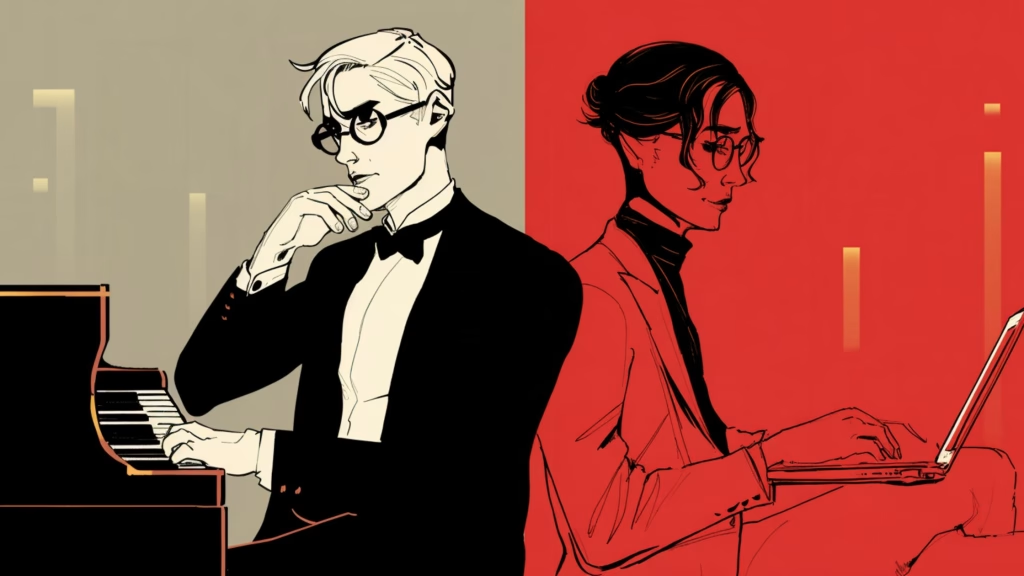
Not every writer needs to write the same kind of story.
Yet a lot of advice points writers toward using the same structures in their stories.
Mostly, I think the advice is meant to be one writer pointing out what works for them and why.
But sometimes writers get caught up in teaching structures as if they were the best, or perhaps only, story structures.
Not every writer needs to write the same kind of story.
***
Something I’ve discovered as I’ve become more experienced as a storyteller is that I like to write stories with underpinnings, that is, deeper meanings. Mostly I do this by writing stories with rhythm and structure, as if they were pieces of music.
For me, the easiest way to embed a sense of rhythm into a story is to put together a music playlist and let my mind wander. I don’t have to plan the structure; my conscious brain and creative brain already worked that out while putting together the playlist.
A lot of hard rock music? There’s gonna be a driving plot with lots of short action scenes. Classical music from the 1800s? A Regency romance, measured and subtle. A lot of soothing electronica music? …well, recently, that type of music turned into a fast-paced action sci-fi story about an android fighting its programming.
The music was important, but as something to fight against: soothing elevator music being force-fed into the background of a tragedy.
While writing the android story, I realized it had underpinnings. I wasn’t just writing the story about the android fighting its programming, but had started adding a layer of meaning underneath it: the tale of how one discovers that not all one’s thoughts are one’s own, but have been introduced externally (as with political or corporate propaganda)—and how we might move on from that.
***
I’m listening to a piece of classical music as I write this: Shostakovich’s Preludes and Fugues, Op.87, Book I, as played by Tatiana Nikolayeva.
Shostakovich was a Soviet-era Russian composer who lived from 1906 to 1975.
He was initially praised for his opera, Lady Macbeth of Mtsensk (first performed in 1934), which “could have been written only by a Soviet composer brought up in the best tradition of Soviet culture.” Then, after Stalin saw the opera in 1936 (and disliked it), it was denounced as a “deliberately dissonant, muddled stream of sounds …[that] quacks, hoots, pants and gasps” and suddenly Soviet music critics were forced to recant their praise in journals and newspapers, claiming that they had failed to detect its shortcomings.
Later, starting in 1948, Shostakovich was persecuted for ten years because his music was seen as too formal—that is, being merely “art for art’s sake.”
In 1960, he finally joined the Communist Party, telling family later he’d been blackmailed into it. Shortly afterward, he wrote String Quartet 8, dedicated “to the victims of fascism and war.” It took three days to write. It’s a brooding, dark piece; a friend of his said later that he thought of it as his epitaph and he’d planned to kill himself after completing it.
Was Shostakovich’s work intended to be purely formal?
Is it supposed to be heard with no other insight than to the cleverness of the mechanical procession of notes? Or with no question of whether or not it aligned with Soviet values at the time?
If so, why?
***
Use the usual story structures. Don’t make it deep, readers hate that.
Don’t write about dissonance, the questioning of assumptions, the unveiling of uncomfortable truths.
Complicated doesn’t sell.
***
Lately I’ll start writing a short story (which I tell myself will take no longer than five thousand words), for example, about an android governess trying to save a child on a space station during an emergency involving a cracked dome in a luxury area of the station.
My goal as a storyteller should be simple: all I need to do is have the android save the child.
I soon reach a point where I cannot.
The way I’ve set up the story prevents me.
The android must follow its programming; also, it was created by a corporation.
Unlike Asimov’s first laws of robotics, where a robot must first not injure a human or allow one to come to harm through inaction, an android created by an unregulated corporation must secretly prioritize not injuring the corporation or allowing it to come to harm through inaction.
The android governess must try to save the child; also, it must try to save the corporation.
The two sets of programming almost always align.
But sometimes dissonance creeps in.
And the corporation wins.
***
Something that’s bothered me a lot about politics these days is that the existence of nation-states—however flawed they might be—seems to be undermined by corporations and the black market, working together both intentionally and coincidentally.
Corporations (and the billionaires attached to them) predate on workers and consumers, steal capital resources, poison the environment on a literally industrial scale, corrupt and/or replace public institutions such as courts, purchase politicians and judges, destroy basic social safety nets…
…and then shift the blame for all this to nation-state governments.
The black market (trading in such things as illegal drugs or underage sex workers) gets leveraged to benefit corrupt members of key institutions, who are protected by plea-bargains and pardons. The profits of the black market are laundered via cryptocurrency and other means…
…while the public demands the nation-state governments to use subverted legal processes to provide the truth behind the corruption.
Cryptocurrency hides money trails, undermines fiat money established by nation-states, and evades the tax money nation-states need to provide basic services and protect human rights. Social media spins out whatever brainwashing is necessary to help this process along…
…until we’re at a point where someone can say “we live in an authoritarian dictatorship” and it’s hard to disagree.
***
When I write, the first third of a story starts out well enough.
I set out a story idea I want to write with characters and setting and an initial conflict for the characters to chew on, throwing in a number of influences that seem random at the time.
Then I play with how they work together and try to solve the problem for the characters. Alas, some of the pieces don’t fit well with each other, and I can’t quite solve the problem. I don’t know how.
Finally I realize there’s some underlying conflict between some of the elements that doesn’t seem to relate to solving the problem directly, but is definitely getting in the way of forward progress.
The second third of a story is frustrating to write.
I can’t solve the characters’ problems. One of the elements forbids it, even as another commands it. As I write, the resolution seems further and further away. The more I write, the more complex the attempts become.
Then something fails, or is revealed as being more broken than anyone knew. (I often don’t know what underpins the story until this point. I’m not really thinking about anything deeper or more meaningful.)
Finally I realize that the whole situation doesn’t work; there was never any way to solve the problem. I’ll often get very upset here and think I’m a terrible writer; I used to abandon stories at this point.
The last third of a story operates on pure hope.
The characters’ goals fail. They lose. And yet the characters keep moving forward, pick up the broken pieces, and realize something: Wait, I can use this. And they start making plans.
This doesn’t work at first. Something always goes wrong when you’re using something broken—including yourself—as a tool. And yet.
The characters learn to let systems of control fail instead of propping them up, to play different sets of rules against each other, to find loopholes and use them without guilt. The bad guys stick to the broken system. Eventually it fails. And the bad guys lose. Because they didn’t know how to survive losing.
The characters still have to deal with the fallout. They don’t get a happily ever after; they only get a tomorrow. But it’s enough.
Aaaand the story is at least nine thousand words long.
***
It’s easy to blame authoritarian dictatorships on hate.
People voted the way they did because they wanted to hurt outsiders more than they wanted to protect themselves.
Trans people. People of color. Immigrants. Anyone.
And yet I don’t think hate is necessary to the process. I think it’s a lack of critical thinking skills that’s the problem.
People aren’t, on average, stupid. (Duh. They’re average.)
But we’re all being trained to react quickly to whatever our surface impression is of what we’re told. We’re being pushed to give opinions now, which means we need information that makes sense now and doesn’t need to be puzzled over. Which means we need complexity reduced to simple, black-and-white categories.
Simplicity, generally speaking, is a pleasant lie.
Critical thinking—that is, the art of asking the hard but insightful questions—is the complex, messy, often disenheartening truth that “truth” isn’t what we think it is.
It doesn’t take hate to create a dictatorship. An overabundance of hope could do it (and has).
All it really takes is the appearance of simplicity—something so clear, elegant, and harmonious that nobody could question it.
***
What emerges when you talk or write or think about writing?
Are you pointing others—and yourself—toward similarity or toward uniqueness and individuality?
Are you looking for the magic answer that makes writing and publishing easy?
Are you looking to keep control of your work, or to let other people manage it for you?
***
My story structure won’t stay the same forever; it wasn’t always like this.
It’s not something I’m doing on purpose. I don’t plan my stories to work out this way; it’s just a side effect of how currently I see the world.
Systems are broken. Brainwashing is pervasive. Critical thinking is hard.
I can try to fight an entire system and get crushed by it, or I can let go of my old goals—and my old beliefs that the system is working in my favor—and navigate the reality of what remains.
I might make it through, I might not, but at least I won’t be brainwashed.—That’s the underpinning of what I’ve been writing now.
It’s not theme or a literary device; it’s just me.
I can’t always see that part of me. I can’t make it something different without losing a part of myself.
But I can observe and use it.
***
Use the usual story structures. Don’t make it deep, readers hate that.
Don’t write about dissonance, the questioning of assumptions, the unveiling of uncomfortable truths.
Complicated doesn’t sell.
***
Shostakovich died in 1975, after I was born but not by much. The Soviet Union fell in 1991. Tatiana Nikolayeva died in 1993 after suffering a brain hemorrhage while playing one of his complex, dissonant fugues.
Neither of them got a happily ever after.
But they did get a series of tomorrows.
I have no idea whether it was enough.
***
Not every writer needs to write the same kind of story.
We’re here to construct our own narratives, not someone else’s.
We’re not being paid to pass on the brainwashing.
We’re not here to write propaganda.
We’re here to write ourselves.
