

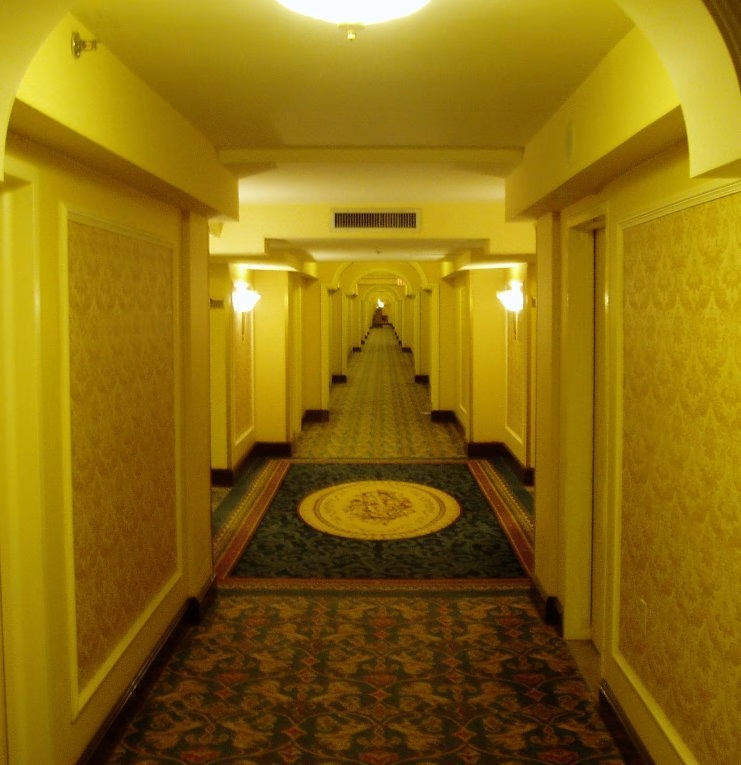
By SimonP – Own work, CC BY-SA 3.0
You’re in a hallway.
The walls are yellow trim with panels of patterned gold wallpaper; the carpet has a green, gold, and scarlet pattern. The carpet pattern is interrupted once by a single green patterned square on the floor, as if to mark a turn toward another hallway or perhaps the elevator, but you can’t see any doors or turnings from where you stand; the length of the hallway is broken by architectural details: fake columns, except they’re boxy and unornamented.
You see the edge of a simple door to the right but not to the left. No handle or lock or nameplate. No hinges. Just the edge of a door, fitted into a doorframe.
At the end of the hall is something, maybe a luggage cart stacked with luggage, maybe a service cart, maybe a stack of cardboard boxes. The lighting is off somehow, as if it had been extracted from daylight and reduced to a chemical formula approximating but not quite capable of replacing it, and it leaves your eyes feeling strained and bleary.
You cannot see any exits or turnings in the hallways. No door numbers (in fact, you can only see the one door, and only its edge). A single air vent overhead, a single speaker (you think it’s a speaker; the ivory shape half-disappears into one wall), a single fire sprinkler head.
It’s not clear how far the hallway continues. It’s like you’re on a movie set, where abruptly the real hallway is replaced by a painted backdrop, but you can’t be sure.
You feel…something.
It’s not déjà vu. It doesn’t feel like you’ve been here before. It’s not surreal. Nothing about this place is out of the ordinary.
And yet.
The concept of “liminal space” comes from the anthropology term “liminality,” or a quality of ambiguity or disorientation that happens during the center of a rite of passage (that is, during a semi-magical/symbolic ritual). Liminality may be associated with feelings of being lost, dizzy, weightless, or lacking grounding or selfhood. While use of the term liminality was originally limited to structured ritual ceremonies, the meaning has since come to include the same quality of ambiguity or disorientation in other contexts of transformation or change as well.
“Liminal spaces,” as a term, refer to existing places or visual media, such as photographs, that create the same sense of ambiguity and disorientation, although such places or images aren’t necessarily associated with rituals or transformation.
Liminal spaces are often in-between places: airports, deserted shops, lightless basements and/or conference centers, long corridors, places devoid of human presence, doorways, tunnels, and other thresholds that depict disjointed settings in proximity. Images may also include elements that bring a sense of artificiality to the image, such as shapes or objects that are repeated or nearly identical, have strong lines of perspective, patterns or textures without strong meaning (such as hotel carpet patterns), unclear contexts, unusually blurry or crisp images, atmospheric effects such as snow or fog. Liminal spaces are often called the “uncanny valley” of images, where it’s not clear whether the space depicted in the image is real or artificial.
Liminal spaces don’t necessarily invoke a sense of déjà vu, and they aren’t surreal. They aren’t necessarily creepy, either: an image of a liminal space can feel devoid of any sort of threat, and still be disturbing.
There’s a fair amount of debate on what a liminal space really is, but here’s my opinion:
A liminal space is essentially a space unresolved in meaning.
A liminal space asks questions:
Is this place real or not?
Does this place feel familiar?
If you can answer those questions with assurance and clarity, the image will not seem liminal. A liminal space should feel indeterminate. You shouldn’t feel safe in a liminal space, but you shouldn’t feel unsafe, either.
You shouldn’t be able to quite put a finger on what’s going on with the space.
And yet.
My question is, as a fiction writer, how can I create liminal space (or a sense of liminality) in fiction? And why should I do so?
Let’s talk about why I’d want to add liminality and liminal spaces to fiction first.
- I want to write about a period of change or transition for a character and I want to make it feel authentically discombobulating.
- I want to show the characters “peeking behind the curtain” and not knowing what to think of it.
- I want to write a story that supports a reader’s understanding of change and transition (for example, a coming of age story that doesn’t feel cut and dried or a story about getting older that isn’t sentimental).
- I want to create a sense of being literally or metaphorically lost in a story for some reason.
- I want to look at the way that our collective sense of reality has been degraded by increasingly cheaply made “fake” places that replace authentic growth: suburbs versus neighborhoods, strip malls versus community gathering, office buildings versus collective effort, even corporate social media versus independent blogs and news groups.
I care about these things; I think our culture is approaching a particular turning point in learning how to collectively deal with, hm, let’s call it Capitalism in general and the Industrial Revolution in particular.
Most fiction is meant to be a comfortable way to pass the time. However, I often write fiction that explores uncomfortable, confusing, and even horrific parts of people’s lives. I don’t want readers to suffer or anything weird like that, but I find exploring discomfort useful on a personal level, and I write fiction to explore stuff and entertain myself and others.
Nothing wrong with comfort. Comfort is nice.
How am I creating liminal spaces in fiction?
I’ve found two different strategies for creating liminal fiction.
The first is to write about liminal spaces and about liminality.
- Set stories in liminal spaces.
- Write about characters going through liminality.
- Write about characters going through liminality as they encounter liminal spaces.
The second strategy is to write in a liminal manner.
- Second person point of view. (“You’re in a hallway.”)
- Repeated words to the point that word starts to lose meaning, also known as “semantic satiation.”
- Unordinary sentences structures, ones that are very short or very long, or with punctuation not normally used in fiction, such as semicolons (;), colons (:), or parentheses.
- Grammatically “incorrect” sentences, especially missing parts of speech; leaving out the subject of the sentence.
- Minimizing or removing emotion from the point of view character’s observations of the setting, so that it almost feels like there is no “self” to the person making the observations.
- A lack of regular or truly parallel structures, so the reader can never develop a “rhythm.” Or excessive use of those structures, so the reader comes to find the structures artificial or suspicious.
I find that writing in this manner feels almost hypnotic—and yet I don’t want to create a hypnotic effect. I often have to back up and disrupt what I write so it doesn’t slip into more comfortable structures; if I read a passage aloud (as in the one above), I stumble as I speak.
What is liminality?
Not the anthropological term but its current usage in popular culture. I’m throwing around the terms “liminality” and “liminal space” in this article like I know what I’m talking about, but I don’t know that I actually do.
When I first started writing this article (in 2024) talked to several people about what they thought liminality was. I asked them if they knew what liminality and liminal spaces meant, and they usually said they weren’t sure what either was exactly, but that they’d heard of it.
I started trying to explain the concepts, and something striking happened: each person latched onto some separate aspect of the idea, I suspect the one that felt most relatable to them personally:
It’s like the transition from spring to summer.
It’s crossing between rooms and you forget what you were doing. (This one was my reaction.)
It’s a change between being a child of someone and being an orphan.
Mostly what I ran into was people saying liminality is a time of transition, any time of transition.
But if that were all that liminality is, why use the term at all?
Why not just call it “change”?
I’m showing my age here, but I wouldn’t call Ferris Bueller’s Day Off a “liminal” movie, even though it has elements that can be identified as liminal, like Cameron Frye’s submerging himself in the pool and thinking about death, or the destruction of his father’s precious car at the weird house in the woods.
But the Overlook Hotel in The Shining, I can think of the hallways and carpets and “know” that setting setting is liminal. The town of Blackeburg, Sweden, in Let the Right One In. That’s liminal. The wealthy family’s house in Parasite.
I’m not sure where I picked up that “knowledge.” I just seem to know it.
A friend of mine who’s an artist said that liminal spaces are like black holes or dark matter; we only know they’re there because things act differently than they’re supposed to.
Part of me wonders whether liminal spaces appear liminal because of the act of photography itself, the ways that glass lenses distort space and how our cell phone algorithms attempt to correct it in ways that look “natural” but don’t quite resemble what we see with the naked eye. I happen to wear thick glasses; for me, real spaces are so consistently and constantly warped by lens curvature that I am unaware of it until I catch a glimpse of something out of the corner of my eye, and
and yet since I started writing this article, I’ve identified liminality in real spaces, particularly now that I’ve moved to Las Vegas and have made a point of visiting different casinos, both on and off the Strip. I’ve also recently watched all of the Kane Pixels Backrooms footage, which very much reminds me of the image of the hotel corridor, and which I was surprised and delighted to find was digitally generated; it seems like the logical epitome of liminal space.
And yet.
I purposefully used a distinct, liminal space in my middle-grade horror story The Witch House (published 2024, written Oct 2023), for reasons I won’t get into here. It’s not based on the Backrooms (either Kane Pixels or the 4chan mythology), but the experience of looking into a friend’s spare bedroom and seeing—for just a moment—nothing but cardboard boxes.
Actually, that’s not true: I didn’t design the space as “liminal” beforehand. I was writing the story and needed a non-real space that was dimensionally between other spaces, but one that I didn’t have to spend a lot of time fleshing out. It needed to be a place that the reader didn’t want to spend too much time in or investigate too deeply: uncomfortable, dull, and disturbing before any logical evidence for horror was presented.
It needed to feel offputting and off.
What emerged from those requirements was liminal, but it was liminal-in-retrospect, not liminal-by-design.
I knew about liminal spaces before that, but only casually; I found out they had become more of a cultural thing in March 2024, because I was trying to explain the experience of writing The Witch House and failing—and my daughter Ray commented that it sounded a bit like the Backrooms.
Rabbit holing ensued: I was delighted to find that there already an existing conversation around what I wanted to talk about, and that other people were encountering the same kinds of spaces, both in real life and as part of their creative meditations about real life.
Later, I wrote this article on-spec for a literary journal; they ghosted me about whether or not they actually wanted the article; subsequently, I forgot about it.
In May 2025, I wrote a short story, “Late Checkin,” where I deliberately used a liminal space; I started with the desire to write a liminal-space story, then wrote the story. The narrative emerged from the technique, rather than the reverse. A character goes to a motel to investigate some possible insurance fraud and enters a liminal space. Hijinx ensue.
Something I noticed during the writing process in 2025, after I had done the reading into liminality, was that I had stronger opinions about the techniques I used to create the liminality, mainly in establishing the concreteness of the world with specific fucking details; for example, there’s some luggage where listing the details in the luggage becomes essential to the plot.
In The Witch House, the liminal space was a tool showing unspoken connections behind events. In “Late Checkin,” the liminal space showed the accretion of casual disregard within a cheap, depersonalized space become something horrific, yet still kinda insurance fraud.
I don’t actually like either space or feel proud of having written them.—The human stories that occur in those spaces, yes, I am proud of writing them. But the spaces themselves turn my stomach in a way that graphic sex or gore does not.
In October 2025, I wrote a sequel to The Witch House called The Witch Labyrinth. I didn’t change the liminal space, but I knew more about liminal spaces by then, and worked more details into it that helped define it a little better. I still hate the space, by the way. Or rather I don’t hate it, I…mentally swerve away from it. My mind doesn’t like to think about it.
Remembering liminal things is tricky.
When something isn’t really one thing or another, you might feel like you remember it, but when you actually go to investigate it, you may not be able to produce memories, but only memories of memories, or the feeling of memories.
And yet.
Fast forward to 2026.
I am working on a trope that I see in various media but isn’t actually on TVTropes.com, a trope that I’m calling “Secretly in Hell?”
The characters are shown in a situation that shows signs of not being quite what the characters think it is, and as the story progresses, we the readers come to understand that the characters are secretly in hell (or in a computer simulation, or the Twilight Zone, or whatever). The characters may or may not ever figure this out and the story may never make this actually clear; the important bit isn’t finding out that you’re in hell, but the disturbing sensation that something is off and can’t put a finger on it. The indefinability, the liminality, is what’s important.
So this morning I sat down to write a tentative article about Secretly in Hell? and say to myself, “Wow, it would be handy to point to that liminality article I wrote back in 2024…whatever happened to that?”
And discovered that nothing had happened to it; it had been abandoned.
An Unnecessarily Brief Timeline of Liminality
Arthur Van Gennep studied rites of passage and folklore in France and first developed the concept of liminality as one of three phases of a rite of passage (pre-liminal or separation, liminal or transition, and post-liminal or incorporation). His best-known work is The Rites of Passage (1909). Here, liminality was defined as the part of a ritual that follows release from a prior social identity (pre-liminal) and before being adopted as part of a new social identity (post-liminal). A description of how magical ritual is used to both trigger and contain transformation in socially acceptable ways. The liminal space is guarded on either end by rituals that keep the “unknowable” quality of the space between one phase and another (like childhood and adulthood) contained. Implication being, if liminality escapes its boundaries, society suffers?
Simulacra and Simulation, a long, pointed, almost sardonic 1981 essay by Jean Baudrillard about the way that modern cultures have become generally detached from reality or indeed any kind of real meaning. Symbols refer to symbols refer to symbols. Simulacra are copies of copies that either no longer have an original, or that never had an original (e.g., Santa Claus). Simulation is the imitation of a real process or event, often so convincingly that it becomes impossible to distinguish from reality (e.g., someone “faking” being sick so well that you can’t tell whether they’re sick or not, as with Munchausen syndrome). (I’m gonna use this more in Secretly in Hell?, later.) Can’t remember if this is the guy who said that a copy of a copy is never exact and therefore the more layers of copying is going on, the more distorted the copy is, until it becomes something else entirely. It’s a paper re: semiotics, which is full of intellectual punks who may have been trying to figure out how to eradicate capitalism, as a parasitic system of “meaning” where no meaning is involved, only the appearance of meaning, sold to the highest bidder.
Threshold Concept, an idea that, once understood, transforms one’s perception. Like a gateless gate from Buddhism? From the 2003 paper “Threshold Concepts and Troublesome Knowledge: Linkages to Ways of Thinking and Practising” by Jan Meyer and Ray Land. I find that liminality is a threshold concept; for example, once you’ve seen an image of a liminal space and been told that other people find this sort of thing disturbing, you may not be able to unsee it. Different from a meme—a meme is any concept that spreads itself, where a threshold concept is like a concept you need to unlock more concepts, and which may or may not spread memetically. Threshold concepts are liminal in nature: they show that the initial pathways of learning something aren’t objective and “true,” but only frameworks of knowledge as a stepping-stone to additional frameworks of knowledge. When people run into threshold concepts, they can have messy emotional reactions—feelings of being lied to, that there’s some sort of conspiracy going on behind the scenes—far out of proportion to the knowledge that’s apparently being learned. Some examples: the fact that gender is not a binary, that “walking on eggshells” is a sign of abuse, that axioms in math aren’t truths but just assumptions that we “agree” are true, that you don’t have to be in a quarantine lockdown in order to work from home in an office job, that “reality TV” shows are scripted.
Backrooms, a fictional location based on the meme of an empty, carpeted room with fluorescent lights and yellowish wallpaper posted in 2011. Became a 4chan thread in 2019. 4chan members created an intricate shared mythology that was ignored by Kane Parsons/Kane Pixels in his series of short, digitally produced Backrooms films on YouTube. One of the ideas I’ve been playing with is the difference between memes (ideas that spread themselves by being so convincing or catchy that they change our underlying assumptions), countermemes (memes that try to out-meme other ideas, while spreading themselves memetically), and antimemes (memes that destroy other memes and/or protect a mind from the invasion of other, disruptive memes: memes that help return autonomy to the individual, instead of making the individual subject to various ideas). Backrooms seems like the antimeme of corporate spaces.
Kenopsia, or the obscure sorrow of places left behind. Neologism created by John Koenig in The Dictionary of Obscure Sorrows, a project to create words for emotions that did not yet have words for them. From kenos, ancient Greek for “empty,” and opsia, from the ancient Greek for “sight.” The Dictionary was first posted on YouTube in October 2014. Oddly, the images for this project do not resemble Edward Gorey illustrations.
liminal thinking as a transition between conscious and subconscious…
most cultures have rituals around the passage from one thing to the next; some liminality is individual and some is social…
the half-floor of Being John Malkavitch…spaceship in 2001: A Space Odyssey…Meow Wolf installations…“Capgras” by Tommy Orange in Never Whistle at Night…
elements of emptiness, transition, and repetition…
transitional liminality: spaces where change and transition happen; nostalgic liminality: you can never go home again; uncanny liminality: the familiar, changed in uncomfortable ways—each reflects a type of memory: memories taken for granted, memories that can no longer be visited in the real world, and memories whose decay has become obvious…
1. bad or perfect lighting, 2. grain or noise in images/sounds, 3. very clean or in good condition, as if only just abandoned a few seconds earlier (food still steaming on a plate in an abandoned kitchen), 4. a good bad camera…
nursing homes as liminality…liminality and mental health…

That’s a really interesting observation about the wallpaper – the way it’s both familiar and unsettling is exactly what creates that feeling of being somewhere that’s not quite right.
I keep looking at the image and going: is wallpaper just inherently creepy? Because I can’t escape remembering Charlotte Perkins Gilman’s “The Yellow Wallpaper.”